Showing posts with label Science. Show all posts

Monday, 31 December 2018

The Plight of Heterozygotes and the Balanced Lethal System of Crested Newts


Heterozygotes have a tough time of it, because no matter how good they are they just can't breed true; heterozyte X heterozygote matings always produce 50% homozygotes. 


Worse, in assortative mating the proportion of heterozygotes will decrease very quickly (and the proportion of homozygotes increase), because the homozygotes will keep to themselves but the heterozygotes will keep producing homozygotes. I suppose in disassortative mating (mating with those different from you) between the two different homozgyotes you will get 100% heterozygotes as a result, but I'm not even sure who heterozygotes would mate with in that situation. I am assuming mating based on genotype (AA with AA, Aa with Aa, aa with aa), ignoring dominance effects that could have, for example, the AA be indistinguishable from the Aa. 

To illustrate assortative mating, I've drawn this (loosely based on a slide from Russell McLaughlin's Population Genetics lectures). To be generous to the heterozygotes, I've started it with 100% heterozygotes for this trait in the population, and you can see that the number of heterozygotes halves each time so it decreases very rapidly. 


Now in the next generation we have 25% of each homozygote, and they stay true and also each get a quarter of the heterozygotes from their parent generation, so they go up to 37.5% frequency. 

(This is all very basic stuff, but it's fun to draw.)


I did a quick Excel graph (I know, the shame, I'm sorry R/ggplot2). This is for one locus and assumes no dominance and complete assortative mating, i.e. individuals of one genotype will always mate with those of their same genotype. You can't see AA because it exactly tracks aa. You can see that the proportion of each homozygote nears (but never quite reaches, though I suppose it would in a non-infinite population) 50% as the proportion of heterozygotes approaches 0%. I hope this is correct but feel free to correct me if not.


This is just how the genetics works. But what if the genotype frequencies have different fitnesses? What if the heterozygote is by far the most fit? Sometimes, this can be resolved by duplicating the gene so that each paralog is one of the alleles, creating a state of permanent heterozygosity to escape the segregational load (Susumu Ohno did say in 1970 that this has risks though, by upsetting the dosage balance of genes, and points to the absence of a duplication of haemoglobin alleles in African populations despite their heterozygote advantage against malaria as evidence for this). 


But what if recombination isn't possible? Crested newts provide a remarkable example of this: 50% of their offspring fail to develop because only heterozygotes for chromosome 1 (1A/1B) are viable. Since only heterozygotes are viable, the parental population will be 100% 1A/1B so 50% of their offspring will be that too and all the 1A/1A and 1B/1B offspring will die. This occurs because 1A and 1B each have a different deleterious recessive allele fixed on a nonrecombining segment (I would reference Grossen et al's 2012 paper in The American Naturalist here, but essentially this entire section is based on that paper so). 

There are various models for how this maladaptive system could have occurred.


  • Sims & Sessions: unequal genic exchange between two homologues of an autosomal pair made crossing over impossible in the region, and then inversions and repeat sequences accumulated. Each haplotype, 1A and 1B, would have a different duplication and deletion affecting something essential to embryonic development, and would show extremely strong negative frequency dependence (their fitness would decrease the more of them there were in the population, I think because if there are lots of them they're more likely to be found in a homozygote and thus their vehicle would die), and should die out. 
  • Wallace et al: chromosome 1 used to be the sex chromosome, though that is now chromosome 4 (male-heterogametic XX/XY system). 1A and 1B used to be an AA/AB sex determining system, and so BB homozygotes are lethal because B accumulated deleterious mutations in the heterogametic form, I imagine because it was shielded by the A and thus could gain deleterious recessive mutations without selective pressure. The issues Grossen et al raise with this are (a) why are 1A/1A homozygotes lethal in the crested newt then? With an AA/AB system there would have been AAs (b) why the new XY system on chromosome 4 only operated in the formerly heterogametic sex (AB). I guess maybe (b) could be the only thing observed because only the AB survives, but if it's saying it only operates at all there then I don't know. 

Instead of these, Grossen et al propose that chromosomes 1A and 1B are forms of the nonrecombining Y chromosome from an ancestral XX/XY system. The Y would have been shielded and safe to develop deleterious recessive mutations such as deletions, and different deletions caused formation of different haplotypes. They discuss and simulate a whole bunch of different paths this could have taken, incorporating the ancestral XX/XY system and the fact that newt sex is partially determined by temperature (males are more likely to develop when it's warmer, females when it's colder - I had no idea of the mechanism behind this at first but apparently it can be related to differential temperature-regulation of genes and activity of enzymes).

Origin of Y haplotypes - the nonrecombining, degraded Y

Because the Y chromosome does not recombine (at least most of it doesn't - in humans the pseudoautosomal regions do), and because in the XX/XY system it's shielded from the effects of deleterious recessive mutations, it has strange evolutionary patterns. 


  • Increased genetic drift - the Y chromosome has an effective population size of 1/4Ne (if you're counting Ne in alleles rather than individuals) because while autosomes are present in two copies in every organism, it is only present in half the individuals of the species and then only in one copy. (Similarly, the X chromosome has 3/4Ne)
  • Selective sweeps and background selection - individual mutations don't really get tested because of the lack of recombination, so if the chromosome as a whole is good they'll stay, if not they'll go
  • Muller's ratchet - again, no recombination, so deleterious mutations are not lost and there are far more deleterious mutations than positive ones so those build up. 
This results in long blocks of Y chromosome that are passed down as-is leading to a couple of Y haplotypes segregating in the population.  Some interesting examples of these haplotypes are mentioned in the Grossen et al paper, including a guppy species with at least 3 coexisting Y variants which code for 'different male coloration morphs and are thus possibly maintained by frequency-dependent selection occurring through female mate choice'. An experiment that mated sex-reversed (i.e. phenotypic not matching genetic sex) XY female guppies with XY males resulted in 25% YY offspring, which were viable as long as their Y haplotypes were different but show a lethal homozygous phenotype. I wonder do these guppies have a sexual selection or disassortative mating mechanism to avoid mating with a guppy with the same Y as them? Are there enough sex-reversed females for it to have evolved? I figure that for an XY female and XY male mating in a system with three Y haplotypes (assumed equal in frequency), for a given XY female there's a 1/3rd chance that her XY male mate has the same Y haplotype as her, which makes a 1/3*1/4  = 1/12 chance that a particular offspring with any XY male mate will be nonviable. 


Two examples of crosses between an XY male and XY female, the first where they have different Y haplotypes and the second where they don't and 25% of the offspring are nonviable.


The other example they give is of Rana rugosa, a type of wrinkled frog, which has a female-heterogametic ZW/ZZ system:


[D]ifferent populations have fixed different W haplotypes, so that WW individuals are viable when their two W chromosomes stem from different populations but not when they are from the same population...[E]ach haplotype has fixed one or more recessive lethal mutations (e.g., loss of function of some housekeeping genes)

So these Y haplotypes can arise. Once that happens, there's a set of steps they lay out to show how this balanced lethality could come about, which I have diagrammed to the best of my understanding below (they didn't phrase it like this set of states and events).


Top row is female, bottom male. Circled A, B and C refer to events while the A, B, C and D on top refer to states.

We start out in state A, with mm referring to a locus on chromosome 4 that will become important in state D, and X and Y referring to ancestral sex chromosomes that are now chromosome 1, with the Y having haplotypes A and B. (I'm now going to say 'X happened' for brevity but it really means 'the authors propose that X happened). 


In this state, there is no 50% offspring mortality, because Y chromosomes don't occur together - they either don't appear at all, as in the female, or they occur alongside an X, which compensates for any deleterious recessive mutations they carry. 

Event A is a climatic or range change that results in decreased temperature, so that - because newt sex is influenced by temperature, and colder temperatures are feminising - some XY newts are females (State B). These females can then mate with XY males as in the Punnett squares above to produce 50% lethal homozygotes (Ya/Ya or Yb/Yb) and 50% viable heterozygotes (Ya/Yb).  This increase in females produced an imbalanced sex ratio which created a selective advantage for an allele that could increase the number of males, i.e. a masculinising allele, to spread through the population. 


Aside box: Why is an imbalanced sex ratio a problem? 
According to Fisher, the reason most sexually reproducing species have a 1:1 sex ratio is because if the ratio is disturbed, the less common sex will be able to get more mates and thus have an advantage, and so if there's any allele that increases the proportion of that sex, it will be favoured by selection and thus more of the less common sex will be born (assuming it costs the same amount of energy to have either sex, which is not necessarily true e.g. males may need more feeding) until the sex ratio equalises. 
My issue with that is - how common are alleles that make an organism more likely to have offspring of a particular sex? This masculinising one in newts is the first I've heard of, but there may be many especially in quantitative temperature-controlled (fully or partially) systems. 


If the temperature gets even colder (Event B), even some YY newts will develop as females and so since there are enough females the X can be lost from the population by drift, resulting in a fully temperature-controlled sex determination process (State C), such as the YaYb newt developing as female if it's colder, or male if it's warmer. 

Event C was the mutation of a locus on chromosome 4 to a masculinising allele (M), which meant the sex-determination system was no longer (fully) temperature controlled but instead determined partly by the presence or absence of the M allele, with Ya and Yb (the two chromosome 1s), as in state C, not acting as sex chromosomes.

If the X had not been lost by drift, they could have evolved to the much better state (without the 50% segregational load) of MMXX/MMXY, but whenever X was eliminated before the appearance of M, this male-heterogametic mmYaYb/mMYaYb system with 50% segregational load was seen.

The authors explored several different paths in their simulations and also looked at the effect of environmental variability (e.g. if it was very cold but there was a lot of variation the temperature spikes gave chances to produce males and avoid extinction) and population size. The paths were:


  • no masculinising mutation on chromosome 4 (i.e. no sex determining chromosomes other than chromosome 1's X/Y) - this meant travelling straight upwards on the diagram below as the temperature decreased.
  • early-occurring masculinising mutation on chromosome 4 - in the simulations, this increased in frequency as the temperature dropped until fixation in the population, with first a female-heterogametic system at T = -4 (mMXX/MMXX), then full temperature controlled sex determination (TSD) at T = -6, with X often being fixed by drift in small populations. This presented a problem when temperatures decreased further to T = -8 because this skewed the sex ratio by creating more females as more MMXX newts developed into females, restoring selection for Y except at high environmental variance, where a few MMXX males would still be born and those would have an advantage because MMXY males mating with MMXY females produced some lethal MMYY homozygotes. If X was fixed and Y had been lost, then either the population would go extinct (small N) or survive with female-biased sex ratios.
  • late-occurring masculinising mutation on chromosome 4: when mmXY (pale green) was still around, i.e. X had not been lost, M was fixed and the original male-heterogametic system was restored (MMXX/MMXY). However, if X had been lost, i.e. the mmYaYb TSD arrangement had been reached before the introduction of M, the YaYb segregational load system was fixed and a male-heterogametic system now based on the X chromosome emerged, with mmYaYb/mMYaYb (dark green female, blue male). That's the one we see today.


Figure from Grossen et al (2012) showing the different paths and results at different temperatures. For example, the optimal path with no segregational load and fixed MM results in females being the red circle and males being purple in the diagram; the current system  is dark green and blue. Being below and to the left of the line indicates femaleness, with the opposite indicating maleness, so in the ancestral state at T = 0 almost all of the mmXX (yellow) newts will be female except for the few in the dotted circle that go past the dark black line, and similarly with the light green mmXY males. As the temperature increases, more and more of the mmXY and eventually mmYY newts will develop as female, e.g. at T = -6 the dotted line goes straight through the middle of the dark green mmYY circle, so about half of mmYYs will be male and half will be female, which would be a temperature-controlled sex determination (TSD) system (this TSD system would also occur at T -6 with the genotype MMXX). 
So there you go - a very complicated system and one whose answer is highly speculative, but interesting due to its gene-environment interplay.

References

1. Grossen et al (2012). The Balanced Lethal System of Crested Newts: A Ghost of Sex Chromosomes Past? The American Naturalist.
2. Charlesworth & Charlesworth (2000) The Degeneration of Y Chromosomes. Philosophical Transactions of the Royal Society London B

(No, these are not properly-formatted references. It's a blog post, these are elleloughranblogspot.ie house rules.)

Sunday, 30 December 2018

Traits and Genetics of Domestic Cat Interspecies Hybrids: Savannah, Bengal, Chausie

I came across savannah cats in a Reddit post and thought they were fascinating, so did a bit of a dive into their characteristics and genetics. Unfortunately, there is a remarkable dearth of papers on them and I am very much not an expert, but I figured it'd be fun to look into it and try to make sense of what I can.

______________________________________________________________

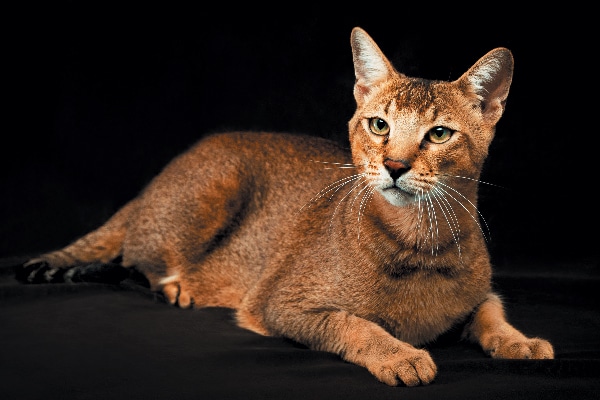
Felidae are genetically very similar, and interbreed frequently with each other in the wild. Humans have also bred certain hybrid cats, especially the Savannah, Bengal and Chausie cats, to be domesticated housepets while keeping the exotic look of their wild ancestors.


Look at all those hybridisation events! (black and red lines). Image from a conference presentation at Tufts Canine and Feline Breeding and Genetics Conference by Dr. William Murphy. 


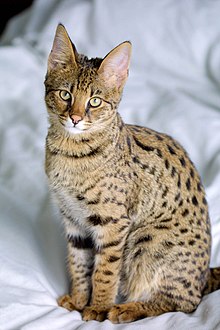
Savannah cat


Chausie cat


Bengal cat

Savannah Cat portrait.jpg
Savannah
Image result for chausie cat
Chausie cat
Bengal


I'm going to mainly talk about savannah cats since those are the ones I'm most interested in. They're generally bred from a female domestic cat (often an Egyptian Mau, ocicat, bengal (another hybrid!) or a domestic shorthair) and a male serval to produce an F1 cat that is 50% serval. This can be backcrossed with a male serval to produce a cat that's 75% serval, but instead these cats are usually backcrossed with domestic cats like so:


Red means % serval in savannah cats of that generation


Until at least F4, the males are not fertile, but the females are fertile from F1 onwards, an example of Haldane's Rule: when in the F1 offspring of two different animal races one sex is absent, rare, or sterile, that sex is the heterozygous sex (heterogametic sex). It can get a bit messy around F5 because those fertile F5 males can now be bred with F1 or other generations of female savannahs, rather than breeding them with domestic cats (outcrossing), and this is now generally preferred to maintain breed type (though probably not great for their health...)

Interestingly, more late-generation male savannahs (F5, F6) seem to be sterile lately, which is suggested by the author of the Wikipedia article to be because of the higher percentage serval savannahs are usually made with lately (due to less outcrossing), or because of the Bengal cat DNA from the foundation of the breed. Both of these relate to a higher percentage of nondomestic cat DNA, which I think from the paper I just read by Davis et al 2015 (which I plan to use as an example in a later blog post about how I annotate papers) could be because sterility relates to the presence of nondomestic haplotypes on the X chromosome. 

Savannahs are known for being playful, intelligent, energetic, enjoying water, and leaping high, like on top of fridges. Both savannahs and Bengals are known to be vocal, with the savannah sometimes miaowing and sometimes chirping like a serval. However, several cat sanctuaries and organisation warn against buying hybrid cats because they can suddenly become aggressive on reaching maturity and 'unlearn domestication' and start peeing everywhere, leading to an excess of surrenders to shelters. Because it's random which 50% of the DNA comes from which parent, you can't know how wild the cat's temperament will remain. I do wonder - to get a bit science fictiony - if that could be controlled via a gene drive or some sort of manipulation of genomic imprinting so you can silence a certain category of genes (e.g. aggression) if they come from a particular parent (e.g. the wild one). Note: even if we could do that, I'm not saying we should. Just an interesting thought.

Genetics of Hybrid Cat Sterility

Davis et al 2015, in their paper Mechanisms Underlying Mammalian Hybrid Sterility in Two Feline Interspecies Models, looked for genes influencing male sterility in savannahs and bengals as compared to fertile hybrids and their parent species (domestic cats, servals, and asian leopard cats). They hypothesized (apparently this is from the Dobzhansky-Muller model, which I need to look up more about) that sterile hybrids would be enriched for SNP alleles from the wild species rather than the domestic one. I liked this study because not only did it do a GWAS, it also did expression level measurement via RNA-Seq to partially verify the GWAS hits, and sometimes also compared to results from mouse knockout studies. I won't go into all the details from it, but the major points I got from it were as follows.

Most of the candidate hybrid male sterility (HMS) loci show very little amino acid divergence between the domestic and wild cat species - the change seems to be in the regulatory regions

They found associations with male sterility for 5 SNPs in savannahs and 3 in Bengals. These included genes involved in the blood-testis barrier, a glutamate receptor, a Ser/Thr kinase and a transcription factor, as well as AKAP9 which anchors protein kinase A, and a DNA methylase that suggested epigenetic effects. There were two interesting links to cAMP, but that may just be because cAMP is involved in a lot. 

The major sterility issues were problems with the blood:testis barrier, with acrosomal (a sperm structure) development, and with transcriptional regulation.

While they say the X chromosome is important in this, they didn't get any statistically significant SNPs on the X chromosome from the GWAS (though they sure try to sneak it in with 'suggestive' and 'approached' significance!). They attribute this to low X SNP density on the array and/or the Large X Effect being especially polygenic due to the long divergence time between the parental species - something I imagine could be investigated using Chausie cats, since they have a divergence time about a third as long (~3 MYA).


Manhattan plots: too pretty for their own good.
Genes on the X chromosome were highly overexpressed compared to autosomal genes. The expression patterns were consistent across both hybrids (Bengals and savannahs). They tried to correct for spurious expression differences caused by different cellular composition in sterile vs fertile testes (specifically, sterile testes have fewer postmeiotic cells which could make it seem like postmeiotic genes were being expressed at a lower level when the expression level per cell was the same) using housekeeping genes, an issue I was introduced to recently via Kevin Mitchell's blog (post here). Sidenote: I really enjoy that blog - dude seems to know what he's talking about. Which is good, since he'll be my lecturer next semester.

Here are their graphs comparing the sterile hybrids' testis gene expression to fertile hybrids and parent species. What I gather from that is that in all six groups, more of the X chromosome genes are in the bins for being overexpressed compared to the other type (fertile hybrid, wild parent, domestic cat), whereas the autosomal genes aren't clustered around the left of the graph so aren't generally overexpressed. The consistency between Bengals and Savannahs suggests commonalities in the reason for sterility among the two breeds, and other similarities with mouse suggest it could go even further.


Ignore my blue writing, if only because it'll be explained in the paper-annotating post.


Questions*
  • Why have cats diverged so little from each other?
  • Why do Bengal males become fertile in earlier generations than savannahs?
  • Haldane's Rule, and its various proposed answers that open up more questions...
  • What are the implications of the relationship between HMS and copy number variation on the X chromosome?
  • Why is it X chromosome blocks from the wild parent, rather than the domestic parent, that seem to induce sterility? Is it because these cats are usually more domestic than wild in ancestry? I'm not sure if this data includes 75% servals etc.
  • Why are there so few studies in this area?? These cats are cool.
  • WHY is the supplemental data in PDF? Please, whoever is responsible for this, whether it's the authors, the journal, or the flying spaghetti monster himself - just put it in a CSV. Thank you.

*some of these questions may well have an answer, but this is what popped into my head.


__________________________________________________________________________________

Finally, have this. Because what's the point of science without a poorly-drawn sketch of a Savannah cat sitting on top of a fridge?


Tuesday, 27 October 2015

British Science Association Youth Panel October Meeting

Hey guys! This is my first blog post written on a computer in a long time because Alice has kindly allowed me to use hers, so shoutout to Alice. I'm going to describe my one-day trip to London in another post, along with what I learned about London and meeting up with some hella cool people. 


The Youth Panel is a part of the British Science Association with around 25 young people with CREST awards aged between thirteen and nineteen. We act as a liaison between the BSA and young people and as ambassadors for various things, including - for some of us - the Wellcome Trust's national Crunch initiative, which educates people about the relationship between our food, our health and the safety of our environment. We'll be meeting a few times a year to discuss and debate things, and also attend events like the Big Bang Fair and British Science Festival. 

So I went over to London on the 24th of October to attend our first official meeting of the 2015/16 year and had a great time. Because it was my first time navigating London on my own and only my second time there ever, I got lost and was late for the meeting, but eventually I got in and it was alright.


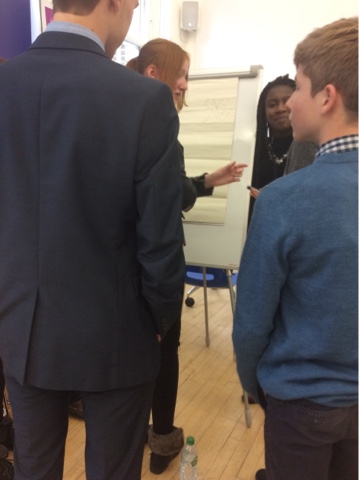
Met Floriane from Outbox!


When I arrived, we were in the middle of a session from Debating Matters, who teach people how to debate and give out information packs on various topics. We debated whether space exploration is a waste of money and time, whether animal testing is ever justified and some other topics I missed. To finish that session we gave them loads of ideas for future debates they could hold with other groups. 


Met Imogen from Outbox!


I was really surprised and delighted when I noticed that here there were rarely any lulls; people had their hand up ready to talk all the time, so no one became that person who constantly asks questions or makes points. I've gone to plenty of events for high-achieving teenagers, but I'd never experienced this to such an extent. It was wonderful that everyone was so engaged. 


We then had lunch and I got talking to lots of interesting people. It's kinda unfortunate that whenever I leave the country any conversation I have with people I meet inevitably turns to the differences between that country and Ireland and that country's history with Ireland, especially if I'm with English people. It's quite problematic. Anyway, these people were really cool and had awesome stories and perspectives. I've met so many new people this year with the most amazing experiences, it's brilliant.


After lunch, we did a session with someone from Telefonica where we were told to think of a problem in the world and figure out a way to alleviate or fix it with a budget of £300 (fun fact: I spent one day in London and I still keep saying "pounds" instead of "euro"). My group chose poverty because of course we couldn't choose an easier target, and were quite alarmed when we were told the budget. So we focused on urban poverty in the UK among old people and proposed using solar panels so they wouldn't have to pay electricity bills - one girl in the group had done her CREST award project on solar panels so she knew the details and how cheap they are. Installation would probably be a bigger problem and limit the reach of the £300, but still. Our presentation was the best even though it was pulled together in a panic in about thirty seconds, and the guy from 02 Think Big/Telefonica said it would inspire him to go out and buy solar panels right then. Ta.


To close out the day, we did a live webinar with Nora Maddock from the Wellcome Trust about their Crunch initiative, where we commented on and provided reactions to and suggestions for the schools programme. It was a really interesting and constructive discussion and Nora is really great. I need to email Nora to follow up on something, actually, but I've lost her email so hopefully the project organiser will send it to me soon. The Crunch initiative is looking for ambassadors so I'm hoping to get involved with that soon, although my location (not in the UK) might be an issue since it's a UK initiative. We shall see. Nora left us cool magazines and a little book from the Wellcome trust.


After the day ended, I met up with Jason from CTYI and Sobelema from Outbox, but I'll describe that in the next post. 

Really interesting day, and I very much appreciate the opportunity to visit London - and work on my navigational skills!


Saturday, 25 May 2013

The Rainbow Virus - Dennis Meredith Review

Publisher: Glyphus LLC
Published: 2 February 2013
Source: Netgalley
Pages: 408
Genre: Adult Science Fiction, thriller.
Rating: 3.5 stars.
Synopsis: The Rainbow Virus is a gripping, realistic bioterrorism tale that launches readers on a harrowing adventure with the flips and plunges of the wildest roller coaster.

At first, loner scientist Arthur Lupo seems the most eccentric bioterrorist of all time. After vanishing from his lab at a biotech company, he releases viruses that only turn their victims a palette of colors. But then his chief pursuers—disgraced FBI agent Bobby Loudon and obsessive CDC epidemic-tracker Kathleen Shinohara—discover a horrifying fact. The brilliant Lupo has stolen the world's most lethal viruses from the Army's bioterrorism center.

Lupo reveals that his first viruses were only a test. He dramatically proves their infectivity by transforming the terrified citizens of Denver into a rainbow of colors. In a chilling declaration, he announces that he will now release an unstoppable artificial virus whose spread will decimate the world's population.

Loudon and Shinohara must race against time, a mysterious assassin, and a secret government faction to find Lupo and stop him.
In Short: Really defied my expectations, a very enjoyable thriller.


Review:
I really liked the idea behind this book. I enjoy anything to do with virology (take Partials, for example) and I mean, he added rainbows! Rainbows! No seriously, the medical aspect was really well-written and interesting, especially to my science-loving mind.

At first, I thought I was going to hate this book. I guess I should've got the YA version, but I had the adult one and so I had the doubtful pleasure of reading the swearwords and comments about ogling women. Oh, and the main character's constant remarks about how hot the female main character is. They're both adults.

Also, the writing style isn't beautiful. Maybe that's too much to ask, but I like it when the prose in a novel carries nice imagery and creative use of language. Here the language is used solely to communicate the story, without much heed paid to the way it's expressed.

On a positive note, the virology was informatively, entertainingly written and Doc and Shinohara's platonic relationship was enjoyable. The information about the FBI and the CDC made for great reading, especially the politics of the departments.

I really liked reading about the different colours people were turning and how that was related to real illnesses and their susceptibility to them. The story bodes ominously for the prospects of bioterrorism, which was one of my favourite parts of it.

The suspense is built up tautly to the end, where it closes on a massive surprise, which I loved. Shinohara shows another part of her character in a bold, admirable move It was also nice that it's a one shot for a change.

I took off 1.5 stars for the references to women that went too far and the fact that the characterisation sometimes fell a little flat, but it's a thrilling storyline. I'd recommend it for light beach reading, especially coming up to summer!

___________________________________________________________________________

I'm sorry for the delay in posting, I've been dealing with exams and a break-up, which both suck. But the exams will be over in a few weeks, and then I'll be back to normal.